Serving All Of Florida and Georgia
Ground-penetrating radar and electromagnetic locating that find what 811 does not — private lines, plastic pipe and abandoned plant — before anyone breaks ground.
811 gets the public utilities marked — and stops at the meter. Everything past it, and everything plastic, is on you. Private electrical feeds, PVC water lines, irrigation mains, septic tanks, old conduit nobody recorded: none of it shows up on a public locate ticket. We scan with ground-penetrating radar and electromagnetic locators, mark what is actually there, and hand you a picture of the ground you can excavate against — before a machine finds it the expensive way.
Professional, reliable, clean and great communication.As far as I am concerned they checked all boxes for us. We will definatly be using them again!

Excellent experience, great job Boring under the street.
Great experience and fairly priced. They got the work done in no time and saved me from trenching through 100’ of parking lot in a busy plaza. Would use them again if the need arises
The boring bros team are amazing! Thank you guys for getting my project done ahead of schedule, it’s been a pleasure working with you guys. I will be sure to use you guys on my next projects!
Boring Bros did an excellent job. They were punctual, cleaned up area upon completion and were reasonably priced. We would definitely recommend them.
Very professional and Levi is amazing!!
811 marks public utilities in the right-of-way, and it stops at the property line. It does not mark the gas run to your generator, the conduit between two buildings, the irrigation main across the lawn or the electrical feed to a sign. Those are private utilities, and they are the ones crews actually hit. We locate them with ground-penetrating radar and electromagnetic equipment, mark them on the surface with depth estimates, and document the result for your file. That is the core of our GPR utility locating services: ground penetrating radar for plastic and non-metallic lines and electromagnetic locating for metal ones, run together on every job.
Three of the jobs our crews run most for carriers, contractors and municipalities.
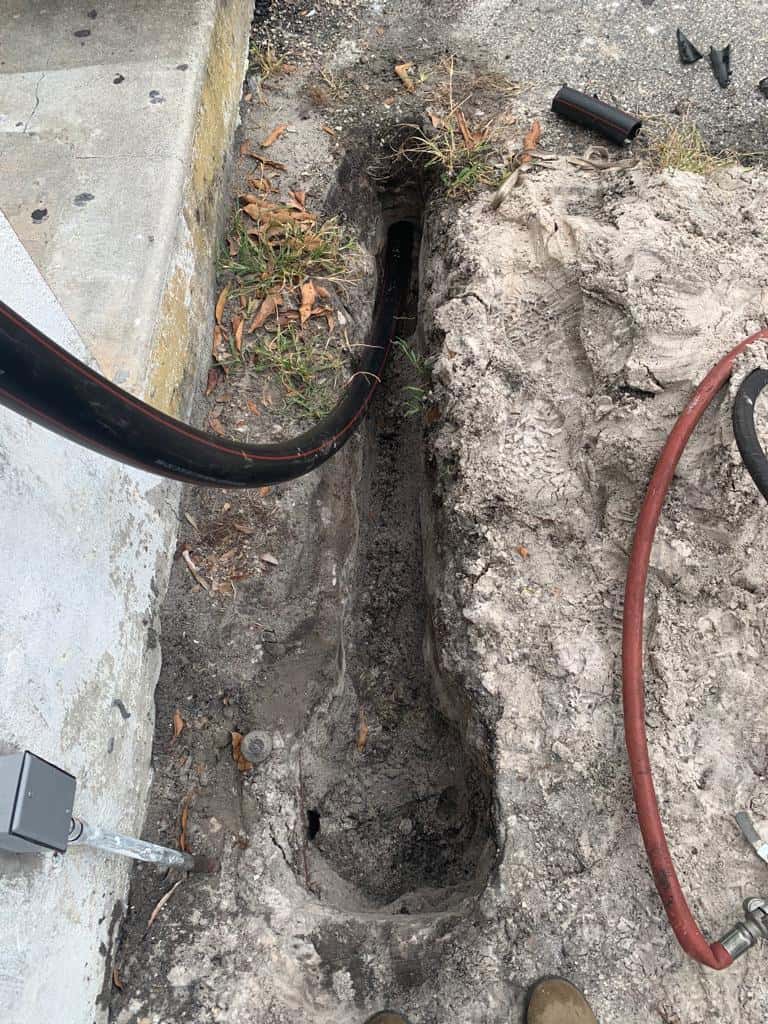
The on-site lines 811 will never mark — gas, electric, fiber, water, irrigation and sewer running between buildings, across parking areas and out to equipment. This is the single most common cause of a strike on private property.

Rebar, post-tension cable, conduit in slab and voids imaged before anyone cores, cuts or drills. A struck post-tension cable is a structural failure, not an inconvenience.
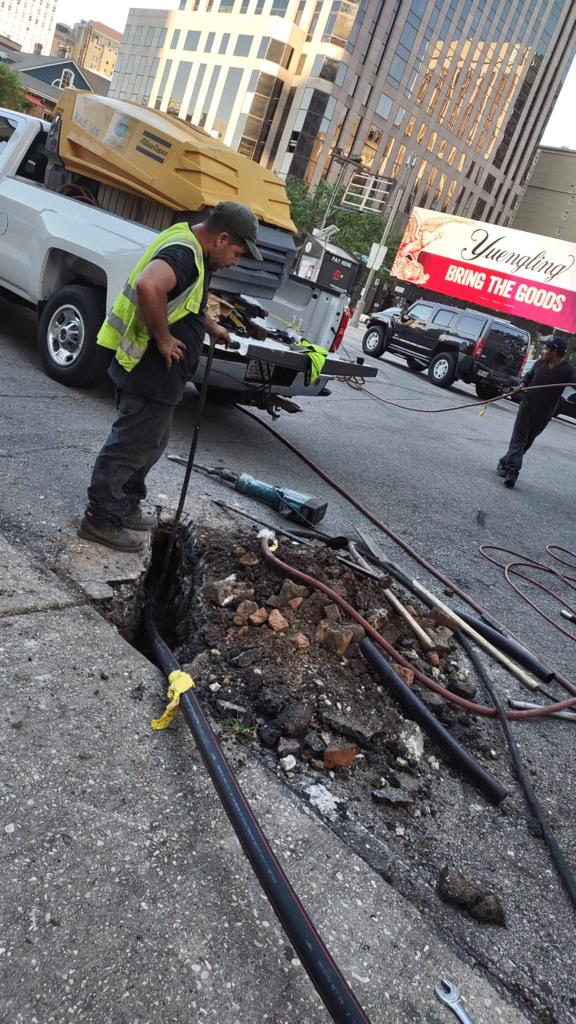
Full sweeps of a dig footprint or a planned bore path, with depths recorded so the excavation crew knows what is down there before the bucket moves.
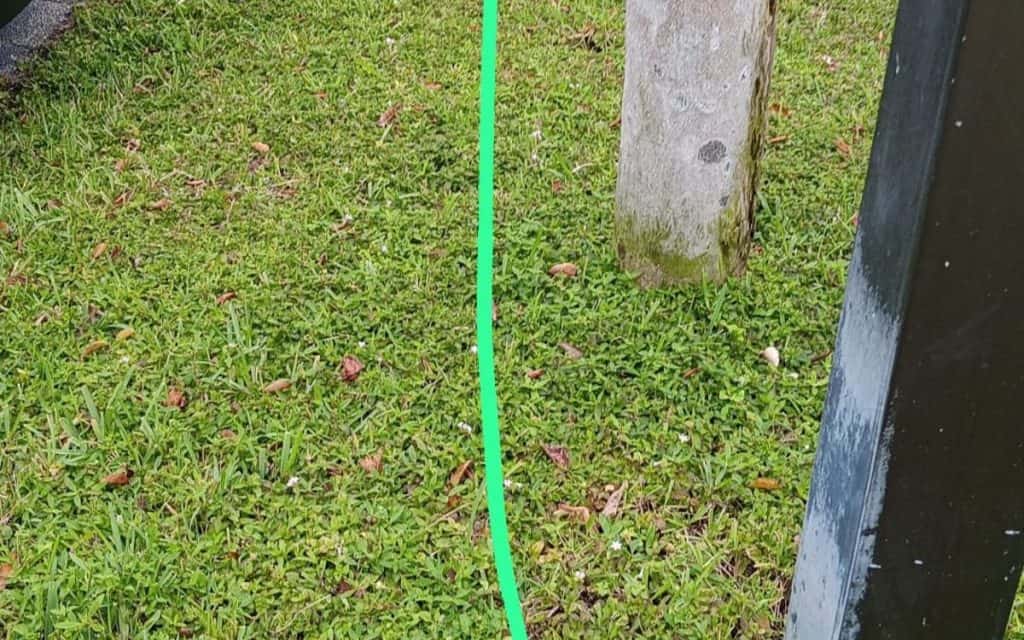
Most of our locating work is for other crews — electrical contractors, fence and sign installers, pool builders, GCs and our own bore crews. Before a drill head or an auger goes in the ground, we sweep the path, mark what crosses it, and flag the depth window where the ground is actually clear.
A pre-bore locate is cheap insurance measured against what a strike costs: a cut fiber line is a five-figure repair before the downtime starts, and a gas hit clears the site. Marks go down in paint and flags per APWA colour code, so any crew reading the ground knows exactly what it is looking at.
If you run the machine yourself, we can stay on site during the dig and re-check as you expose — verification while excavating, not just marks before it.
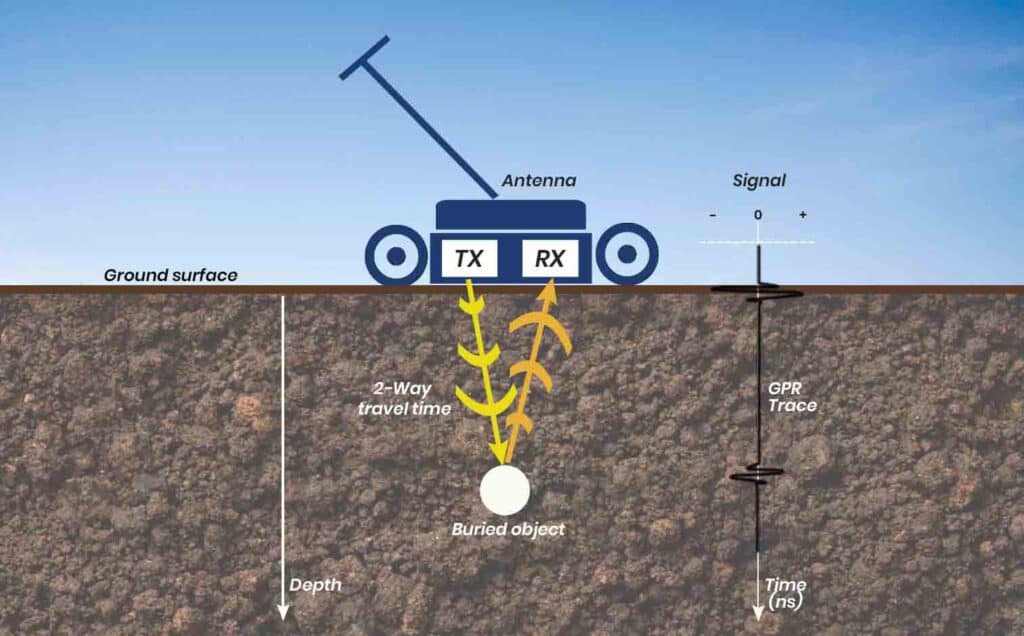
Electromagnetic locators need metal — a conductive pipe or a tracer wire — which is exactly what PVC water lines, HDPE gas services, terracotta drains, septic systems and fifty-year-old conduit banks do not have. That is where ground-penetrating radar earns its keep: it reads density changes in the ground, so it sees the plastic pipe, the abandoned duct, the old tank, and the things no drawing ever mentioned.
Florida’s sandy soils are among the best GPR conditions in the country, which is why we get useful depth and clean signal on most private-side scans. Where soil, moisture or congestion muddies the signal we say so and cross-check with a second method rather than handing you a guess dressed up as a finding.
Every anomaly gets marked at its position with an estimated depth, and photographed before we leave. See our GPR utility locating service areas across Florida.
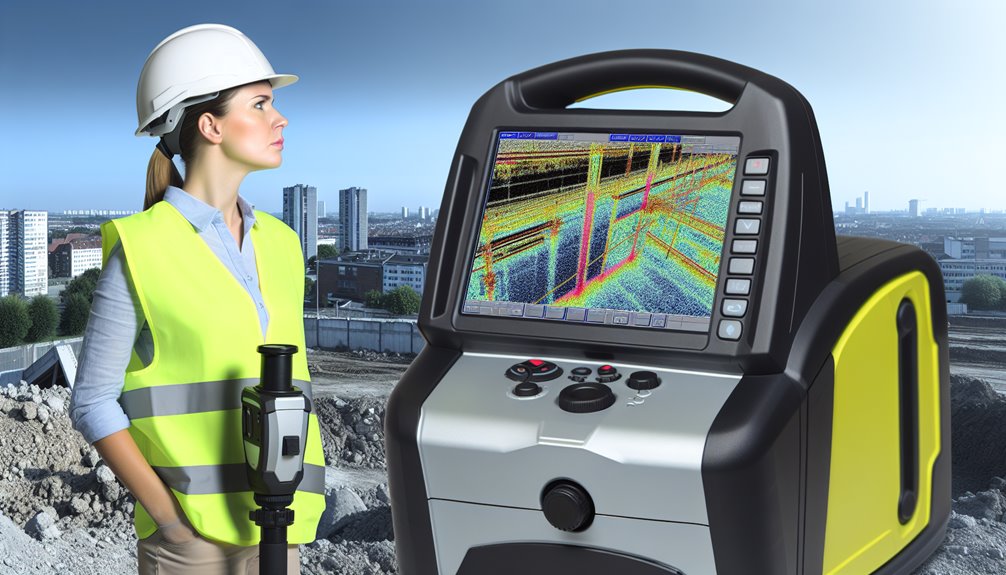
Marks on the ground disappear with the first rain. When a project needs the findings to outlive the paint — a design in progress, a permit package, a campus that keeps digging into surprises — we turn the locate into documentation: photos of every mark tied to fixed references, measured offsets, and a sketch or overlay the engineer can drop into the plan set.
Verification runs the other way too. When a drawing says a duct bank is three feet off the building line and nobody trusts it, we scan the corridor and either confirm the as-built or correct it before someone designs around a line that is not where the paper says it is.
For repeat clients we keep the record, so the next job on the same site starts from what we already know instead of from zero.
Networks live or die on the pathway they run in. We install the conduit, duct bank and cable that carry fiber, power, data and signal — without opening the surface above them. Once a safe route is confirmed, our technology infrastructure boring crews can install fiber, power and data pathways without opening the surface.
PVC, HDPE, clay, concrete and asbestos-cement lines carry no traceable signal, so a standard electromagnetic locator cannot see them at all. Ground-penetrating radar reads the physical contrast in the soil instead, which is why it finds plastic water lines and clay sewer laterals that every other method walks straight past.
Gas to the generator, electric to the pump house, fiber between buildings, irrigation across the property, low-voltage to gates and cameras. None of it falls inside the 811 scope, and all of it is live.
Rebar mats, post-tension tendons, conduit cast in slab, voids and buried structures — mapped and marked on the surface before a core bit or saw touches the concrete.
Old tanks, capped lines, forgotten conduit and plant that appears on no drawing anyone still has. Unknowns are exactly what makes a dig go wrong, and they are the reason as-builts alone are not a locate.
Tell us the site, the footprint and the dig date. Most locates are scheduled within days and quoted the same day you call.
Four stages on every locate, whether it is a slab scan or a full site sweep.
We define the work area with you and confirm the 811 ticket is in. Public locating is free, it is the law, and it is the baseline — our work verifies and extends those marks, it never replaces them. Anyone telling you otherwise is selling something.
Ground-penetrating radar runs alongside electromagnetic locating on every job. EM traces metallic and energised lines directly; GPR catches the non-metallic ones EM cannot see. Neither method alone covers a site, which is why running one and calling it a locate produces the strikes.
Findings are painted and flagged on the surface in APWA colour code, with depth estimates recorded as we sweep. Where the signal is ambiguous we say so on the spot rather than marking a guess.
You get the marked site plus a record of what was found and at what depth — for the permit file, the excavation crew, and the argument nobody wants to have later about who knew what.
They are not competitors — they cover different ground, and a safe dig usually needs both. This is where the line actually falls.
Call 811 for…
The public side: gas, water, sewer, power and telecom mains in the right-of-way, up to the meter or the service point. It is free, it is the law before you dig, and the utility owners send their own locators. What it does not cover is anything past the meter, anything privately owned, and anything the owners have no record of — which on a commercial site is most of what is actually in the ground. An 811 ticket on a clear lawn can still be hiding a septic tank, a well feed and an irrigation main.
Call us for…
Everything 811 walks past: private electrical between buildings, water and irrigation laterals, septic and drain fields, low-voltage and camera runs, abandoned duct, and any non-metallic line a standard locator cannot energise. Private locating is also the answer when the stakes are high enough that “probably clear” is not good enough — directly over a bore path, next to a hospital feeder, inside a slab about to be cored. We scan it, mark it, photograph it, and put our name on the result. For private-locate work north of the state line, review our GPR utility locating coverage in Georgia.
Who hires us to locate, and what it saves them.
A strike stops the job, injures crews, and the repair bill plus the outage claim lands on whoever was digging. A locate costs a fraction of one hit.
Post-tension cable, rebar and in-slab conduit found before the bit goes in. This is the cheapest structural insurance on any renovation.
Engineers, surveyors and designers who need to know what is actually under a site before a route is committed to paper.
Documented subsurface conditions for permits, property transactions and the disagreements that follow a damaged line.
Work with an underground construction contractor whose crews do this every day.
Modern rigs, locating gear and tooling maintained to keep bores accurate and schedules intact.
Our crews bring more than two decades of hands-on trade experience — running as Boring Bros LLC across Florida and Georgia since 2021.
You will usually reach an owner at Boring Bros — brothers Aaron and Levi Cohen run the company themselves. Every crew on your job is a licensed, insured contractor (Boring Bros LLC, Florida Doc. L21000515203; Georgia Control No. 25100779; certificate of insurance on request). We have run bore-and-trench crews across Florida and Georgia since 2021, backed by 20+ years of trade experience on the crew.
Years In The Trade
Family-Owned
70+ Google Reviews
Insured
Six answers get you a firm price and the right equipment on the truck. Half-known is fine — send what you have and we will tell you what actually matters for your site.
Not sure what is under a site at all? Start with the scan — it is the cheapest thing that ever happens on an excavation.
Honestly: less deep than most people expect, and it depends entirely on the ground. In dry sandy soil — much of Florida — useful depth is commonly around six to eight feet. In heavy clay, saturated ground or after rain, that can drop to two or three feet, and Georgia red clay is genuinely difficult. Antenna frequency is the trade-off: a lower-frequency antenna reaches deeper but resolves less detail; a higher one gives sharp shallow images and little depth. Anyone quoting you a single depth figure without asking about your soil is guessing.
It is not x-ray, and pretending otherwise causes accidents. GPR struggles in wet or heavy clay soils, cannot reliably resolve very small targets at depth, and returns ambiguous data where the ground is full of fill, debris or overlapping utilities. It does not identify what a line carries — it shows an anomaly, and interpretation is the skill. Where the picture is unclear we recommend potholing to confirm visually rather than marking a line we are not sure about.
Industry rates for professional GPR locating generally run in the range of $800 to $1,500 per day, and most firms including ours apply a minimum site fee because mobilising a technician and equipment costs the same whether the site is small or large. Price depends on site size, surface type, how much concrete scanning is involved and whether documentation is required. We quote per site rather than pretending an hourly rate covers it.
Always, and it is free. 811 is a legal requirement before excavation and it covers public utilities in the right-of-way. Private locating is the second step — it covers everything on your side of the meter, which 811 will not mark and which is where most strikes on commercial and residential property actually happen.
Public locating is the free 811 service. Member utilities mark their own facilities up to the point of service — the main in the street, the service to the meter. Private locating covers everything beyond that: the lines the property owner owns. If a line runs from your meter to your building, past your building to a second building, or out to equipment on your site, 811 will not mark it and no utility is responsible for it.
Yes. Slab scanning maps rebar, post-tension cable, conduit and voids, and the results are marked directly on the concrete so the cut or core location can be adjusted before anyone starts. On post-tensioned structures this is not optional — a severed tendon is a structural repair.
They are estimates, and we report them as estimates. GPR infers depth from signal velocity through soil, and that velocity changes with soil type and moisture, so a reading taken in dry sand and the same reading after three days of rain are not the same. Where exact depth matters — tie-ins, tight clearances, anything you are going to dig within inches of — we recommend potholing to expose and confirm.
Florida and Georgia — from our South Florida yard in Hollywood and our Atlanta office. See our service areas for local detail.
Yes — that is the main reason to use it. Standard electromagnetic locators need metal to induce a signal onto, so PVC, HDPE and terracotta are invisible to them unless a tracer wire was buried with the pipe. GPR reads density contrast instead of conductivity, so plastic pipe, concrete duct and even voids show up. In Florida’s sandy soils plastic services image particularly well.
It depends on the soil more than the equipment. In clean, dry sand — most of Florida — useful depth commonly reaches several feet, well past the depth of most private utilities. Wet clay and salt-saturated ground absorb the signal and cut that down sharply. We tell you on site what the conditions are giving us rather than quoting a brochure number.
At minimum, marks on the ground: paint and flags per the APWA colour code, at position, with estimated depths noted. If the job needs it to survive the weather we add photographs of every mark tied to fixed reference points, measured offsets, and a simple drawing or plan overlay your engineer can use. Say what you need when you book and we scope for it.
Constantly — it is most of the work. Electrical contractors clearing a trench line, GCs de-risking a site before earthwork, pool and fence crews, and bore crews (including our own) clearing a drill path. We mark it, document it, and get out of the way of your schedule.
Tell us the footage, the product and the window — we will get you a real number, usually same day.